
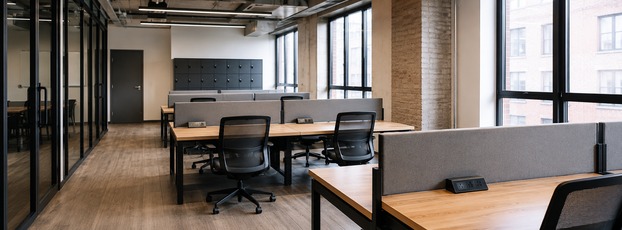
 If you use an office or other workspace to run your limited company, most of the associated costs can be paid by the business. This includes conventional office rent, as well as serviced and coworking spaces and, in many cases, virtual office services.
Here we look at the main office expenses your company can claim, and a few costs which need to be treated differently.
Can a limited company claim office expenses?
Yes. If your company rents premises used for its business, the normal running costs are usually allowable expenses for Corporation Tax purposes.
As with other limited company expenses, the basic rule is that the cost must be incurred wholly and exclusively for the purposes of the business.
HMRC specifically includes rent for business premises, business rates and insurance among the costs which will normally be deductible.
This means that if your company rents an office from an unrelated landlord and uses it for its business, the rent should normally reduce the company’s taxable profit.
Which office costs can your company claim?
Depending on the type of premises you use, allowable costs may include:
- office rent;
- serviced office or coworking fees;
- business rates;
- electricity, heating and water;
- business premises insurance;
- cleaning and security;
- repairs and maintenance;
- office furniture and equipment;
- stationery, printing and postage; and
- internet and telephone services.
Not everything on this list will necessarily be treated in the same way for tax purposes. Some purchases, particularly furniture and equipment that will be used for several years, may be capital expenditure rather than ordinary day-to-day expenses.
Tax relief may instead be available through capital allowances. We explain the distinction in more detail in our guide to capital and revenue expenses.
Serviced offices and coworking spaces
You don’t need to take out a conventional office lease for the cost of a workspace to be a company expense.
If your company pays for a serviced office or coworking membership which you use for business, the cost will normally be allowable. This might be a permanent desk or office, or a more flexible arrangement where you pay for access by the day or month.
Many serviced office fees include electricity, broadband, reception services, and cleaning in a single charge. There is generally no need to separate these individual costs if your company is simply paying a commercial fee for the business workspace.
Keep the invoices or membership agreement with your other company records.
Can your company pay for a virtual office?
A virtual office can also be a legitimate company expense.
These services are commonly used by small companies which do not need permanent office space but want a business address away from the director’s home.
A typical virtual office package might provide a business correspondence address, mail handling or forwarding, telephone answering and occasional access to meeting rooms.
If the service is purchased for the company’s purposes, the cost should normally be deductible when calculating its taxable profits.
Some providers also allow you to use the address as your company’s registered office. There are specific Companies House rules about which addresses can be used for this purpose, so read our guide to choosing a registered office address before signing up.
What about meeting room hire?
If you don’t have a permanent office, your company can pay to rent a meeting room or workspace as needed.
For example, you might occasionally hire a room to meet a client, interview somebody or hold a company meeting. Provided the hire is genuinely for business purposes, the cost should normally be allowable.
The same principle applies to ad-hoc desk or office hire when you need somewhere to work away from home.
Office furniture and equipment
Desks, office chairs, monitors, printers and other equipment bought for company use can qualify for tax relief, although larger or longer-lasting purchases may need to be treated as capital expenditure.
In many cases, capital allowances mean the company can still obtain tax relief for the full cost of qualifying equipment in the year it is purchased.
For computers, monitors, printers and similar items, see our guide to computer hardware and software expenses.
What about an office deposit?
If you rent an office, you may need to pay a deposit. As this is normally refundable at the end of the tenancy, it isn’t an allowable expense when you pay it; instead, it is recorded on your company’s balance sheet.
Repairs and improvements are not always the same
The company can generally claim the cost of ordinary repairs and maintenance to business premises it occupies.
There is an important distinction between repairing something which already exists and making a significant improvement to the premises.
Routine maintenance or restoring something to its previous condition will often be a revenue expense. Work which creates or substantially improves an asset may instead be capital expenditure.
This distinction can become important if you fit out an office or carry out substantial work before moving in, so check the treatment with your accountant if significant sums are involved.
What if you work from home?
The rules are different if you work from your own home rather than renting separate business premises.
Your company can pay you £6 per week (£26 per month) towards the additional costs of working from home without you having to provide evidence of the extra expenditure. There are other ways to deal with qualifying homeworking costs.
Read our guide to working from home expenses for the full rules.
It is also possible in some circumstances to enter into a rental agreement under which your company pays you for the business use of part of your home. This needs more care because the rent you receive personally has its own tax implications. See our guide to charging your limited company rent for a room in your home.
Some final points
Keep invoices and receipts for office costs with your company’s accounting records, particularly when you use flexible workspaces or pay for services personally and later reclaim them from the company.
If an office-related cost has both a business and a personal element, don’t assume the full amount can be automatically claimed.
Read our guide to dual-purpose expenses, which explains how the rules work where an expense has more than one purpose.
Recommended Contractor Accountants
- Aardvark Accounting – All-inclusive – £89 per month, no catch-up fees
- Bright Ideas Accounting - £119/month, 5-star Google rating
- SG Accounting – First 3 months at £59.50 pm, no catch-up fees
- Clever Accounts – IR35 FLEX – take on any contract you are offered
- Integro Accounting – 6 months fixed fee accountancy - half price!