
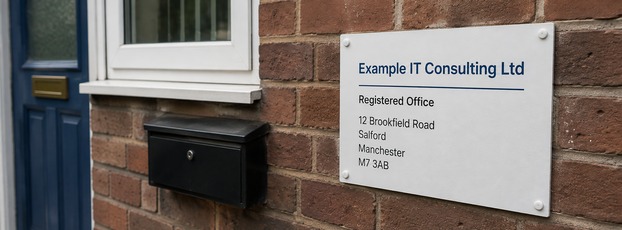
 When you form a company for the first time, you’ll have to provide Companies House with several addresses, the most important one being your registered office address.
Section 86 of the Companies Act 2006 requires a company to keep its registered office at an ‘appropriate address’ at all times.
This means an address to which documents delivered by post or hand would reasonably be expected to come to the attention of someone acting on behalf of the company, and where delivery can be acknowledged.
If a company does not maintain an appropriate registered office address, the company and its officers may commit an offence. Companies House can also move the company to a default address. If the company then fails to provide an appropriate replacement address, it could ultimately be struck off the register.
This is the official address of your limited company or limited liability partnership and will appear on the public record.
In addition to a registered office address, you must also provide Companies House with a registered email address.
This email address is used by Companies House to contact your company about official matters and reminders, but it is not published on the public register.
You can read the official guidance here: company address rules on GOV.UK.
In this article, we explore your options for selecting a registered office address, along with the requirements and restrictions that apply.
Which jurisdiction?
Your company’s registered office must remain within the jurisdiction in which the company is registered: England and Wales, Wales, Scotland or Northern Ireland.
If you set up a company in England and Wales, the registered office address can be in either England or Wales. However, if your company is registered specifically in Wales, its registered office must remain in Wales.
You can change your registered office address at any time, provided the new address remains within the company’s registered jurisdiction.
Your company’s registered address
You must provide a physical street address for your limited company (including a postcode), which serves as its mailing address for official correspondence.
PO Boxes, Legal Post numbers (LP), DX numbers, or similar mail-only services are not permitted, even with a postcode.
You need a real physical location, such as your home, an office, or a third-party registered office service provider that meets the appropriate address requirements.
Public record
Your registered office address is publicly available on the Companies House register. You can use your home address as the registered office address, but it’s advisable to give this some thought.
Using your private address means clients, suppliers and anyone else can see where you live, and there is always the practical risk of business-related correspondence or visitors turning up at your home.
And if you live in rented accommodation, there may well be a clause in your agreement to say you can’t register a business at this address.
For all of the above reasons, many choose to protect their privacy by providing an alternative registered office address.
Options include using an accountant’s or solicitor’s address, or one provided by a company formation service that will forward mail to you. Please note that a fee will be charged for this service.
Most limited company accountants will be happy to provide their office address for your company’s use.
Alongside the privacy this offers you, it also makes a lot of sense, as your accountant will typically deal with any official correspondence sent to your company.
Directors who don’t want their home address displayed publicly should also consider which service address they provide to Companies House.
Mail to your registered office address
Your company’s registered office address is where statutory, legal and other important documents may be sent by HMRC, Companies House and other official bodies.
The type of correspondence you receive may include Companies House reminders, notices relating to company tax and VAT returns, legal notices, late-filing penalties and information about PAYE and National Insurance contributions.
Your company is responsible for filing its annual confirmation statement with Companies House.
Other requirements
You can only provide one registered office address for your company. As mentioned above, this may not be the address where you work or trade from, but the one that appears on the public record and the address to which statutory and legal mail can be sent.
Changing your registered office address
If you decide to change your registered office address, the key thing is that the new address must remain within the same jurisdiction as your company’s registration (England and Wales, Wales, Scotland, or Northern Ireland).
In practical terms, you notify Companies House by filing form AD01 (online or by post).
There is no fee to change your registered office address, but you will typically need your company authentication code to file online.
Your address does not officially change until Companies House registers the update. For 14 days after the change is registered, documents can still be validly served at your previous registered office address.
Previous registered office addresses will also remain visible in the company’s filing history on the Companies House register.
Read the official guidance on choosing or changing your registered office address here: Companies House: how to choose or change your company’s registered office address.
GOV.UK also covers the AD01 process here: Change a company’s registered office address (AD01).
What’s a service address?
As part of the company formation process, all company directors and LLP members must also provide a service address.
This is the director’s official correspondence address, as shown on the public Companies House register.
As such, you can again choose to protect your privacy by using your accountant’s address or a similar service.
Read more in our guide to service addresses.
Registered office services are available to provide privacy
If you would rather not use your residential address as your company’s official address, you can use one of the many third-party services to do so on your behalf.
Recommended Contractor Accountants
- Aardvark Accounting – All-inclusive – £89 per month, no catch-up fees
- Bright Ideas Accounting - £119/month, 5-star Google rating
- SG Accounting – First 3 months at £59.50 pm, no catch-up fees
- Clever Accounts – IR35 FLEX – take on any contract you are offered
- Integro Accounting – 6 months fixed fee accountancy - half price!