
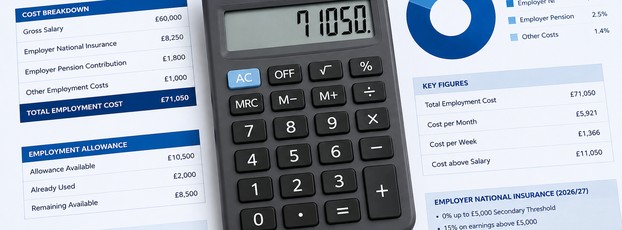
Calculate the true cost of employing someone in 2026/27, including salary, Employers’ NI, pension contributions and other employment costs.
%
Where selected, the calculator applies any remaining Employment Allowance against this employee’s Employer NI.
£0
£0 per month
•
£0 per week
£0
£0
Employment Allowance applied
−£0
Employer NI after Employment Allowance
£0
£0
Other annual employee costs
£0
£0
£0
£0
£0
Figures are annual estimates for 2026/27. Employment Allowance is an employer-level allowance, so only select it if you want to use the remaining allowance against this employee’s Employer NI.
Our partner limited company accountants
- Aardvark Accounting – All-inclusive – £89 per month, no catch-up fees
- Bright Ideas Accounting – £119/month, 5-star Google rating
- SG Accounting – First 3 months at £59.50 pm, no catch-up fees
- Clever Accounts – IR35 FLEX – take on any contract you are offered
Employer National Insurance rates in 2026/27
For a standard National Insurance category A employee, employers pay Class 1 Employer National Insurance at:
- Up to £5,000 per year – 0%
- Above £5,000 per year – 15%
The £5,000 limit is known as the Secondary Threshold.
For example, an employee earning £60,000 has £55,000 of earnings above the Secondary Threshold. Before any Employment Allowance is applied, the Employer NI cost is therefore £8,250.
You can read more in our National Insurance guide, or check the official HMRC National Insurance rates and thresholds.
What is the Employment Allowance?
The Employment Allowance can reduce an eligible employer’s Class 1 National Insurance bill by up to £10,500 per tax year.
It applies to the employer’s overall National Insurance liability rather than separately to each employee. This is why the calculator asks how much of the allowance has already been used.
For example, if your business has already used £8,000 of its allowance, £2,500 remains available. The calculator can use this remaining amount to reduce the Employer NI allocated to the employee you are calculating.
Not every company can claim the allowance. In particular, a limited company cannot normally claim where it has just one director and that director is the only employee liable for Employer National Insurance.
See the HMRC Employment Allowance eligibility rules for full details.
How much does an employee really cost?
An employee’s salary is only part of the cost to the business.
Depending on your circumstances, the total cost may also include:
- Employer National Insurance
- workplace pension contributions
- bonuses and commission
- private medical insurance and other benefits in kind
- training and professional subscriptions
- equipment and software
- recruitment costs
You can enter any additional annual costs in the Other annual employee costs field.
If you’re employing somebody for the first time, see our guide to taking on your first employee.
Employer pension contributions
The calculator allows you to enter the employer pension contribution as a percentage of the employee’s full gross salary.
For example, a 3% employer contribution on a £60,000 salary adds £1,800 to the annual employment cost.
This is deliberately a simple employer-cost calculation. It does not calculate statutory automatic-enrolment contributions using qualifying earnings.
Under the standard automatic-enrolment rules, the minimum employer contribution is generally 3%, and in most schemes qualifying earnings for 2026/27 fall between £6,240 and £50,270.
See the GOV.UK workplace pension contribution guidance for more information.
What about employees under 21, apprentices and veterans?
The calculator assumes a standard National Insurance category A employee.
Different Employer NI rules can apply to some employees, including qualifying employees under 21, apprentices under 25 and eligible veterans. In these cases, Employer National Insurance may be charged at 0% up to a higher threshold.
These special NI categories are not included in this calculator.
HMRC lists the current rates and thresholds in its National Insurance rates and allowances.
Paying an employee through PAYE
Once you employ staff, salary, tax and National Insurance are normally dealt with through payroll under PAYE.
Employers generally need to report payments and deductions to HMRC through Real Time Information (RTI) each time employees are paid.
If you’re setting up payroll for the first time, you may also need an Employer PAYE Reference.
Assumptions and notes
- The calculator uses 2026/27 Employer National Insurance rates and thresholds.
- We assume a standard National Insurance category A employee.
- Employer National Insurance is calculated at 15% on earnings above the £5,000 Secondary Threshold.
- Special National Insurance categories, including qualifying employees under 21, apprentices under 25 and eligible veterans, are not included.
- The employer pension percentage is applied to the employee’s full gross salary. It does not calculate minimum automatic-enrolment contributions using qualifying earnings.
- Employment Allowance is only applied where you select it and is limited to the amount of allowance still available.
- Employment Allowance eligibility is not determined by the calculator.
- Other employee costs can be entered separately, including benefits, insurance, equipment, software and training costs.
This calculator is for guidance only. Actual employment costs will depend on the employee, your pension scheme and the circumstances of your business.