
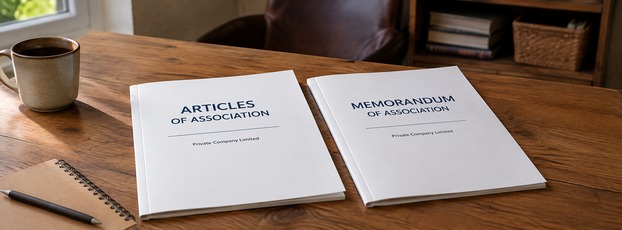
If you want to form a new company, alongside the Companies House application itself (IN01), you must also file Articles and a Memorandum of Association. Here, we explain what these documents are and how to submit them.
Whichever method you choose to incorporate a company (directly via Companies House, via a formation agent, or an accountant), you will have to supply the same documentation to the Registrar.
All of the fine details relating to your proposed company formation are contained in the application form (IN01) used to set up a limited company, including the company name, address, and details of shareholders and company directors.
The other two components are:
The Memorandum lists all subscribers to the new company and notes their intention to establish the enterprise.
The Articles act as a ‘rule book’, governing how the main aspects of running the company work in practice.
Most of our readers won’t have to formally submit either a Memorandum or Articles of Association to Companies House.
In most cases, the standard documents are generated automatically when you incorporate a company online.
These will automatically be submitted as part of the standard formation process, whichever method of incorporation you decide upon. We’ve provided this article for the sake of completeness – for anyone thinking of setting up a company.
Do you need to submit Articles and a Memorandum yourself?
In most modern company formations, you will not need to manually prepare or upload these documents.
If you form a company online using Companies House or a formation agent, the Memorandum of Association and the standard Model Articles are automatically generated and submitted as part of the process.
Only companies that use custom Articles of Association will normally need to provide their own documents during incorporation.
When would you need bespoke Articles of Association?
The standard Model Articles are perfectly adequate for most small limited companies.
However, you might need to consider bespoke Articles if your proposed company structure is more complex. For example:
- Where there are multiple shareholders with different rights or share classes.
- Where you want tighter control over how shares can be transferred or sold.
- Where investors are involved and require specific protections or voting rights.
- Where the company forms part of a wider group or joint venture.
In these cases, a solicitor or accountant will normally draft the Articles on your behalf and submit them as part of the incorporation process.
Memorandum of Association
Prior to the implementation of the Companies Act 2006, the Memorandum was a much more substantial document.
Under the 1985 Act, information such as the company’s name, registered office, share capital, and shareholders was also required.
The Memorandum is now a simple document confirming that the initial subscribers wish to form a new company, agree to become members and, where the company has share capital, to take at least one share each.
The document contains the following details:
- The company name.
- Date of incorporation.
- Whether the company is limited by shares or guarantee.
- The following statement: “Each subscriber to this memorandum of association wishes to form a company under the Companies Act 2006 and agrees to become a member of the company and to take at least one share.”
- Names and signatures of all subscribers.
You can download a template for companies with or without share capital from Companies House.
All information previously collected in the pre-CA 2006 Memorandum is now contained in the IN01 application form.
Articles of Association
The Articles of Association serve as the ‘rulebook’ for how a limited company is to be run. They include things like:
- The appointment (and termination) of company officials – directors and secretaries.
- The role and responsibilities of directors, and their powers.
- How directors’ decisions are made, including conflict resolution.
- How shares are issued, and distributions (dividends) are made.
- How shareholders’ decisions are made, including meetings, voting, amendments, etc.
- The relationship between shareholders and the company.
- Company administration issues, such as insurance matters.
Many companies opt to use the standard Model Articles prescribed under the Companies Act 2006. You can see the Companies House guidance and examples here.
If you decide not to use the Model articles, you may not be able to complete the incorporation directly via Companies House online services. In practice, most contractors use a formations agent or accountant to submit bespoke Articles as part of the incorporation process.
Practical points to remember
- Your Articles should be kept at your company’s registered address.
- If your company decides to amend its Articles of Association, the directors must notify all shareholders. A general meeting will be required to make the change by special resolution (requiring at least 75% approval). Subsequently, the revised articles, together with proof of the resolution, must be sent to Companies House within 15 days.
- If you have a shareholders’ agreement, you (or your solicitor) should ensure that it aligns with the terms of the Articles.
- Make sure you read our popular guide – set up a limited company.
Recommended Contractor Accountants
- Aardvark Accounting – All-inclusive – £89 per month, no catch-up fees
- Bright Ideas Accounting - £119/month, 5-star Google rating
- SG Accounting – First 3 months at £59.50 pm, no catch-up fees
- Clever Accounts – IR35 FLEX – take on any contract you are offered
- Integro Accounting – 6 months fixed fee accountancy - half price!