
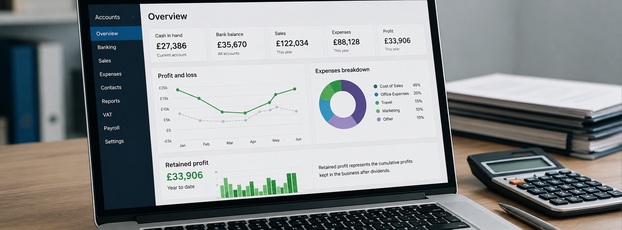
 Retained profit is the profit your limited company has built up over time after paying its business costs, taxes and dividends, rather than taking all of the available profits out of the company each year.
The money stays in the company and can be used to cover future costs, buy equipment, provide a cash reserve or support the business during quieter periods.
How does retained profit build up?
A profitable company does not have to distribute all of its profits to shareholders.
Any profit left in the company after tax and dividends contributes towards its accumulated reserves, which can build up over several accounting periods.
For example, if your company has £30,000 of retained profit brought forward from previous years. It makes another £50,000 profit after tax this year and pays £35,000 in dividends.
Its retained profit would increase to £45,000.
The calculation is:
£30,000 + £50,000 – £35,000 = £45,000
Over several years, your retained profits can build into a sizeable reserve within the company.
Is retained profit the same as money in the bank?
No. Your company could have £50,000 of retained profit without having £50,000 sitting in its bank account.
Some of that profit may already have been used to buy equipment or other assets. The company may also be waiting for customers to pay outstanding invoices.
Equally, don’t assume that a healthy bank balance is all yours to take out. Some of it may be needed to pay Corporation Tax, VAT, PAYE or other bills which haven’t fallen due yet.
This is why your bank balance isn’t a reliable measure of either your company’s profit or the amount available to pay as dividends.
This is why looking at the bank balance alone does not tell you how profitable your company is or how much you can safely withdraw.
Read our guide to the balance sheet and profit and loss account.
Where does retained profit appear in company accounts?
The profit or loss made during the year is shown in the company’s profit and loss account.
Retained profits appear on the company’s balance sheet as part of its reserves. Depending on how the accounts are presented, you may see them described as retained earnings, profit and loss account or simply reserves.
This gives you a better picture of what the company has built up over time than looking at the bank balance alone.
Can you take retained profit out as dividends?
Potentially, yes, you can.
A company can pay dividends from profits available for distribution. This includes qualifying profits retained from previous accounting periods as well as profits made during the current period.
So if your company has built up sufficient reserves over several years, it may still be able to pay a dividend during a year in which current trading has been poor.
But you need to establish that sufficient distributable profits actually exist before declaring the dividend.
For more information, read our guide to limited company dividends.
Can you pay dividends if the company makes a loss?
A loss this year doesn’t necessarily mean you can’t pay dividends. If the company has profits left over from previous years, there may still be enough available to pay one legally.
For example, if the company starts the year with £40,000 of distributable profits from previous years and then makes a £10,000 loss, it could still have £30,000 available.
Before declaring the dividend, check that the company still has enough distributable profit available to pay it.
For more information, read our guide to paying dividends when your company has made a loss.
What happens if you pay more dividends than the company can afford?
Company directors should not simply decide how much they want to withdraw and then record the payment as a dividend.
A dividend must be supported by sufficient distributable profits.
If it isn’t, you may have an unlawful or illegal dividend to deal with. The tax and accounting treatment will depend on what happened and whether the shareholder knew, or had reasonable grounds to believe, that the distribution was unlawful.
For more information, read our guide to illegal dividends and what happens if your company pays too much.
You should also keep the correct paperwork when dividends are declared. We have dividend voucher and board minutes templates you can use.
Why would you leave profits in your company?
You don’t have to take all of the company’s available profits as dividends.
Leaving some profit in the company gives you money to fall back on if there’s a gap between contracts, as well as cash for equipment, insurance, training and other business costs.
You might also choose not to take all of the profit straight away for tax reasons. A large dividend could push you into a higher tax band, so taking some of it in a later tax year may result in a lower personal tax bill.
Speak to your accountant before making this decision, particularly if the company has built up substantial retained profits.
For the current dividend rates and allowances, read our guide to dividend tax and the dividend allowance.
Does retained profit reduce Corporation Tax?
No. Leaving profit in the company doesn’t reduce your Corporation Tax liabilities.
Corporation Tax is calculated on the company’s taxable profits for the accounting period.
Whether you subsequently distribute some of the post-tax profit as dividends or leave it in the company does not alter the CT liability on the profits.
For more information, read our Corporation Tax guide for contractors.
What happens to retained profit when you close the company?
If your company eventually stops trading, any money and other assets left in it need to be dealt with before the company is closed.
How you extract the remaining funds at that stage can have different tax consequences, depending on the amount involved and whether the company is struck off or placed in Members’ Voluntary Liquidation (MVL).
If you’re considering closing a solvent company with significant retained profits, speak to your accountant before withdrawing the funds.
For more information, read our guide to Members’ Voluntary Liquidations for contractors.
Use accounting software to keep track of retained profits
You don’t need to wait for your accountant to prepare annual accounts to find out how the company is doing.
Keep your bookkeeping up to date so you have a clear idea of the company’s profits and liabilities before paying dividends.
This is easier than ever thanks to an abundance of great accounting software (e.g., the excellent FreeAgent).
If you use accounting software and keep your records up to date, you should be able to see how much retained profit the company has at any point during the year.
This is particularly useful if you pay dividends regularly, as you can check that sufficient profits are available before declaring one.
Make sure your invoices, expenses and other transactions are entered promptly. If the figures in your accounting software are out of date, the retained profit figure will be too.
If you’re unsure how much profit is available for dividends, ask your accountant to check the figures before declaring one.
For more information on what your accountant should be doing for your company, read our guide to limited company accountant duties and responsibilities.
Recommended Contractor Accountants
- Aardvark Accounting – All-inclusive – £89 per month, no catch-up fees
- Bright Ideas Accounting - £119/month, 5-star Google rating
- SG Accounting – First 3 months at £59.50 pm, no catch-up fees
- Clever Accounts – IR35 FLEX – take on any contract you are offered
- Integro Accounting – 6 months fixed fee accountancy - half price!