
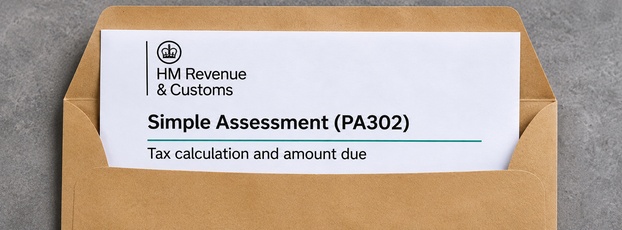
 If you’re not currently in the Self Assessment system, perhaps due to a change in trading structure or a return to permanent work, you might have received a bill for unpaid Income Tax, known as a Simple Assessment, or form PA302.
The letter explains how much tax HMRC believes you owe, how it arrived at the figure and when you need to pay.
In July 2026, HMRC announced it would issue around 1.8 million Simple Assessment letters for the 2025/26 tax year.
Although contractors who already complete Self Assessment returns are unlikely to be affected, you might receive a PA302 if you’ve stopped working through your own limited company, moved into permanent employment or started working through an umbrella company.
In this guide, Mahmoud Lababidi, Tax Manager at SG Accounting, explains why HMRC issues these letters, how to check the figures and what to do if you disagree.
Why has HMRC sent you a Simple Assessment?
HMRC uses information from various sources, including employer records, pension providers, banks and building societies, to work out if individuals have paid the right amount of tax.
And if the tax authority believes you’ve underpaid, it may be able to collect the shortfall by adjusting your PAYE tax code. And if this isn’t possible, it may issue a Simple Assessment instead.
Some common reasons include:
- There is an Income Tax underpayment of £3,000 or more.
- Savings interest or dividends haven’t been taxed.
- You had income from a second job which hasn’t been taxed correctly.
- You owe tax on pension income.
- You’ve received more Personal Allowance than you’re entitled to.
You can find out more in HMRC’s Simple Assessment guidance.
Why might a contractor receive a PA302?
If you’ve spent several years contracting through your own company, you’re likely familiar with completing annual Self Assessment returns.
If you close your company, make it dormant, or have moved to permanent employment (including working through an umbrella company), you may no longer need to file a tax return, especially if you have no significant sources of income beyond your contract work.
However, HMRC may still identify a potential underpayment in subsequent tax years. You might have received dividends before closing your company, or earned savings interest that hasn’t been taxed.
If you’re still required to file tax returns, any shortfalls should usually be dealt with via Self Assessment.
See our Self Assessment guide for contractors and company directors for more information.
Check HMRC’s figures before making a payment
The PA302 form will show your income and any tax that has already been paid, plus the amount outstanding.
Don’t assume that the calculation is correct.
Check the figures against your P60, P45, payslips and any records of other income. This is particularly important if you’ve changed jobs or moved between PAYE and limited company work during the year.
Also check that any savings interest figures are correct, especially if you have several accounts.
You can also see the information HMRC holds through your Personal Tax Account.
What if you think the HMRC calculation is wrong?
You have 60 days from the date of the assessment to get in touch with HMRC if you disagree with the figures. Explain why you disagree, and include any supporting evidence.
HMRC may then issue an amended assessment. If it rejects your challenge, you can appeal within 30 days of the date of HMRC’s decision letter.
You still need to pay by the original deadline unless HMRC agrees to delay payment. If HMRC postpones payment while your case is considered, make sure you have confirmation in writing.
See the steps you need to take to challenge a Simple Assessment here.
What are the Simple Assessment deadlines?
For the 2025/26 tax year, your deadline will depend on when HMRC issued your letter.
- Before 31 October 2026: payment is due by 31 January 2027.
- On or after 31 October 2026: you have three months from the date of the letter.
You can make a payment online, via the HMRC app or by bank transfer. You will need the 14-character payment reference beginning with X.
Read more in HMRC’s guide: how to pay a Simple Assessment.
What if HMRC sends you another PA302?
You can receive more than one Simple Assessment for the same tax year.
In October 2026, HMRC began issuing further calculations involving interest earned on bank and building society accounts during 2025/26.
If you receive a revised PA302, the new assessment shows the total tax due, rather than an additional amount on top of the original bill.
Check whether HMRC has accounted for any payments you’ve already made.
What if you already complete Self Assessment returns?
If you’re registered for Self Assessment for the same tax year, contact HMRC or your accountant before paying a PA302.
HMRC has advised accountants to ask for a Simple Assessment to be withdrawn if their client is already registered for Self Assessment for the same tax year.
The key is to make sure the same tax isn’t collected twice. Similarly, if you’re due a refund from simple assessment, do not claim it before speaking to HMRC or your accountant.
If you’ve already paid tax or claimed an overpayment via simple-assessment, and you will be filing/have already filed a self-assessment tax return for the same period, then you need to factor that into your self-assessment submission to ensure that you are not overpaying tax or claiming a tax refund that you may not entitled to.
Our partner accountants
- Aardvark Accounting – All-inclusive – £89 per month, no catch-up fees
- Bright Ideas Accounting - £119/month, 5-star Google rating
- SG Accounting – First 3 months at £59.50 pm, no catch-up fees
- Clever Accounts – IR35 FLEX – take on any contract you are offered
- Integro Accounting – 6 months fixed fee accountancy - half price!