
When you incorporate your limited company, you may have assets which you want to transfer into it. But how do you go about this, and what tax rules should you be aware of?
In this guide, Kerry Newman, Head of SG Accounting explains how asset transfers work in practice.
Reasons to transfer assets
If you already own equipment such as computers or office equipment, you can transfer it to your company rather than buying everything again. If the assets qualify, the company may also be able to claim tax relief on them.
How to value your assets
To begin with, you’ll need to use the market value when valuing your assets.
The process of transferring assets is fairly simple, so long as you take a realistic approach to how much they’re worth.
For example, if you transfer older assets to your company, you should use their market value on the date of transfer, rather than the original purchase price.
The market rate should take into account the asset’s age, condition, and specification. You can research the second-hand market online to help support your valuation.
The longer the gap between purchase and your company’s incorporation, the harder it is to justify a higher value.
Separately, you may be able to claim the cost of pre-incorporation expenses incurred up to seven years before the company started trading, provided the costs meet HMRC’s criteria.
Once the asset has been transferred, your company may be able to claim capital allowances based on its market value. The amount and timing of the relief depends on the type of asset and the capital allowance rules that apply.
Records you need to keep when you transfer assets
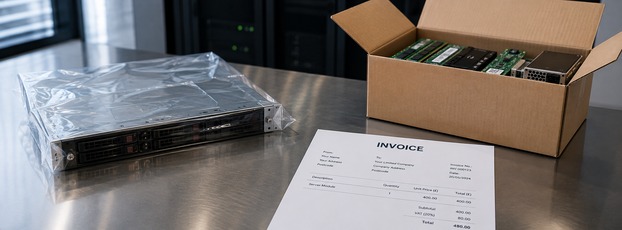
Before transferring the asset, create an invoice from yourself to the company. Your accountant should be able to provide a template if you need one.
The document should include:
- Your name
- Your address
- Your limited company’s name
- The date of the invoice
- A clear description of the assets being transferred
- The agreed market value
Keep any original purchase invoices as evidence that you owned the assets personally beforehand.
Once you have created the invoice, your company can then reimburse you for the agreed value. In practice, this is often recorded via your director’s loan account rather than an immediate cash payment.
How the asset transfer works in practice
Your company may be able to claim tax relief when it buys business assets, although the cost isn’t deducted directly from its profits.
Instead, the tax treatment is handled through a system of capital allowances.
In many cases, you can claim relief under the Annual Investment Allowance (AIA), which allows the full cost of qualifying assets to be deducted against taxable profits.
For example, if you transfer a PC to your company with a market value of £2,000 and the full £2,000 qualifies for capital allowances, a company paying Corporation Tax at 19% could reduce its tax bill by £380.
Where an asset is available for personal as well as business use, how you treat it from an accounting point of view depends on the type of asset and how it is used. So, naturally, you should check whether the transfer could create any benefit in kind implications for both the company and the director.
Can you transfer a car into company ownership?
You can transfer a car you already own to your limited company, although it may not be the most tax-efficient option.
Corporation Tax relief for cars is restricted and depends on CO2 emissions. In many cases, the relief is spread over several years rather than provided upfront.
If the car has outstanding finance, you will need to check the terms and conditions you agreed to with the finance provider.
Whether the finance can be settled, replaced or otherwise dealt with will depend on the agreement, as your company is a separate legal entity.
If the company provides the car for personal use, benefit-in-kind (BiK) charges will apply.
Each year:
- The company pays Class 1A National Insurance on the benefit
- You pay income tax on the taxable benefit, which may be reported to HMRC on form P11D or dealt with through payroll
The value of the benefit depends on the car’s list price, CO2 emissions, and fuel type. If fuel is also provided, an additional fuel benefit charge applies. See our guide to P11D forms and taxable benefits for more information.
In many cases, contractors are better off keeping the car personally and claiming mileage instead.
See our guide to company car tax for a detailed breakdown.
Seek professional advice before you transfer larger assets
As you can see, there are several factors to consider before transferring assets into your limited company.
For higher-value items, or anything with mixed personal and business use, it is worth taking advice before proceeding.
Your accountant can make sure you’ve valued the asset properly and recorded the transfer correctly in your company accounts.