
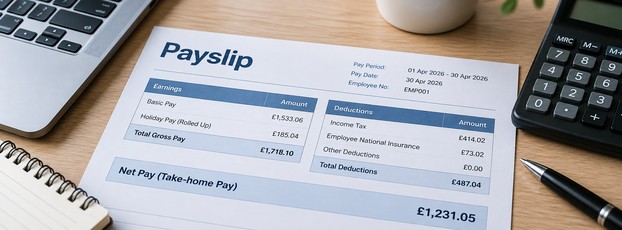
It can be challenging to understand how your net pay is calculated when you receive your first umbrella company payslip. However, the payslip itself is fairly straightforward once you understand what to look for.
The most important thing to understand is that your assignment rate is not the same as the gross taxable pay shown on your payslip.
An umbrella payslip shows your gross pay and the deductions made from it, such as PAYE Income Tax and Employee National Insurance. Before this point, the assignment income received by the umbrella must also fund employment costs such as the umbrella margin, Employer National Insurance and the Apprenticeship Levy.
This guide explains how the two stages fit together, what the main figures mean and what you should check when your payslip arrives.
Assignment rate and gross pay are not the same thing
When you work through an umbrella company, your agency or end client pays an assignment rate to the umbrella.
This rate is normally higher than the gross salary which eventually appears on your payslip because it also has to cover the costs associated with employing you.
These commonly include:
- the umbrella company’s margin;
- Employer National Insurance;
- the Apprenticeship Levy; and
- employer pension contributions, where applicable.
These are employment costs. They are different from deductions such as Income Tax and Employee National Insurance, which are taken from your gross pay.
The reconciliation statement comes first
Many umbrella companies provide a separate reconciliation or pay statement showing how the assignment income received from the agency is converted into your gross pay.
For example, if there are no employer pension costs and the umbrella margin is £30 per week, an assignment payment of £1,748.10 could reconcile to gross pay of £1,500 like this:
| Assignment income | £1,748.10 |
| Umbrella margin | – £30.00 |
| Employer National Insurance | – £210.60 |
| Apprenticeship Levy | – £7.50 |
| Gross pay available | £1,500.00 |
The important point is that Employer NI and the Apprenticeship Levy are accounted for before your employee gross pay is established.
Once gross pay has been worked out, the normal employee payroll deductions are applied.
Then comes your umbrella company payslip
A typical umbrella payslip may contain:
- basic pay;
- holiday pay;
- gross taxable pay;
- PAYE Income Tax;
- Employee National Insurance;
- pension contributions, where applicable;
- student loan repayments, where applicable; and
- net pay.
Worked umbrella payslip example – 2026/27
Here is a simple worked example showing what an actual weekly payslip could look like.
To make the calculation reproducible, we have used Tax Week 1 of the 2026/27 tax year and assumed:
- gross taxable pay of £1,500.00;
- tax code 1257L;
- England, Wales or Northern Ireland Income Tax rates;
- National Insurance category A;
- no pension contribution;
- no student loan; and
- no previous pay or tax in the tax year.
On £1,500 of gross pay in Tax Week 1, this worker would take home £1,073.14. PAYE Income Tax is £358.20 and Employee National Insurance is £68.66.
1. Gross pay – £1,500.00
We are starting at the point where the earlier umbrella reconciliation has established that £1,500.00 is available as gross taxable pay.
If rolled-up holiday pay is being used lawfully for the worker, the £1,500 could be split like this:
| Basic pay | £1,338.45 |
| Rolled-up holiday pay | £161.55 |
| Total gross pay | £1,500.00 |
The holiday pay has not been deducted from the worker. It forms part of the £1,500 gross pay and is simply identified separately on the payslip.
Where a worker qualifies for rolled-up holiday pay, the holiday element should be shown separately.
Read our guides to umbrella company holiday pay and the rolled-up holiday pay rules.
2. PAYE Income Tax – £358.20
For 2026/27, tax code 1257L gives a weekly tax-free amount of £242.
So, from £1,500 gross pay:
£1,500 – £242 = £1,258 taxable pay
The weekly basic-rate band is £725.
The PAYE calculation is therefore:
| £725 at 20% | £145.00 |
| Remaining £533 at 40% | £213.20 |
| Total PAYE Income Tax | £358.20 |
An actual worker’s PAYE deduction can vary from one payslip to another because tax codes and cumulative pay and tax during the year affect the calculation.
3. Employee National Insurance – £68.66
Employee National Insurance is calculated separately from Income Tax.
For 2026/27, a standard category A employee pays:
- 8% between the weekly Primary Threshold of £242 and the Upper Earnings Limit of £967; and
- 2% on earnings above £967.
The calculation is:
£725 × 8% = £58.00
plus:
£533 × 2% = £10.66
So:
Employee NI = £68.66
4. Net pay – £1,073.14
We can now calculate the amount actually paid to the worker:
| Gross pay | £1,500.00 |
| PAYE Income Tax | – £358.20 |
| Employee National Insurance | – £68.66 |
| Net pay | £1,073.14 |
So, in this example:
£1,500.00 – £358.20 – £68.66 = £1,073.14
This is the amount which would reach the worker’s bank account, assuming there are no other deductions.
What does each item on your payslip mean?
Basic pay
This is the main element of your gross taxable pay.
Do not confuse basic pay with the assignment rate your agency pays to the umbrella company.
Holiday pay
Umbrella workers are entitled to paid holiday.
Holiday pay may be accrued or, where the legal conditions are satisfied, paid as rolled-up holiday pay.
Where rolled-up holiday pay is used, the holiday element should be clearly identifiable rather than disappearing into a single headline pay figure.
Gross pay
Gross pay is your taxable salary for the payroll period before employee deductions.
If rolled-up holiday pay applies, basic pay and holiday pay may be listed separately but together make up the gross-pay figure.
PAYE Income Tax
Your umbrella company deducts Income Tax through PAYE and pays it to HMRC.
The amount depends on your taxable pay, tax code and circumstances.
For most employees, PAYE operates cumulatively. This means the tax deducted can take account of pay and tax from earlier in the tax year rather than treating every week in isolation.
Employee National Insurance
Employee NI is deducted from your gross pay through payroll.
This should not be confused with Employer National Insurance, which forms part of the earlier employment-cost calculation.
Pension contributions
If you are enrolled in your umbrella company’s workplace pension, your employee contribution should appear where applicable.
Some umbrella contractors instead make pension contributions via salary sacrifice. See our guide to umbrella salary sacrifice pensions.
Student loan repayments
If you have a student loan or Postgraduate Loan and earn above the relevant threshold, repayments can also be deducted through payroll.
Net pay
Net pay is the final amount remaining after deductions from gross pay.
It should match the amount ultimately paid into your bank account.
Why can two umbrella payslips look different?
Different umbrella companies use different payroll systems and layouts.
Some provide a separate reconciliation statement. Others present more of the assignment-rate calculation alongside the payslip itself.
There can also be legitimate differences because of:
- your tax code;
- pension contributions;
- holiday pay arrangements;
- student loan repayments;
- salary sacrifice;
- the payroll frequency; and
- your cumulative tax position.
The layout may therefore vary considerably even though the underlying PAYE calculation follows the same rules.
What should you check on your umbrella payslip?
Start with the reconciliation between the assignment income and your gross pay.
You should be able to identify the main employment costs rather than seeing unexplained amounts disappearing from your assignment rate.
Then check the payslip itself.
Look for:
- the correct gross pay;
- your tax code;
- PAYE Income Tax;
- Employee National Insurance;
- holiday pay, where applicable;
- pension deductions;
- student loan deductions; and
- the final net-pay figure.
The amount transferred to your bank account should agree with the net pay shown.
Payslip verification is increasingly important
Contractors have always had good reason to check their payslips, but payroll compliance has become even more important across the umbrella supply chain.
Since April 2026, new joint and several liability rules mean recruitment agencies – or end clients where there is no agency – can potentially become liable where PAYE is not accounted for correctly by an umbrella company.
As a result, agencies have a much stronger financial reason to make sure the umbrellas in their supply chains operate payroll properly.
Some umbrella companies now use independent payslip verification services to check payroll data on an ongoing basis.
What if your umbrella payslip doesn’t add up?
Start at the beginning rather than concentrating only on the amount that reached your bank account.
Follow the money through:
assignment income → employment costs → gross pay → employee deductions → net pay.
If you cannot follow the calculation from one stage to the next, ask your umbrella company to explain it.
There should not be unexplained deductions which the provider cannot account for.
Be particularly cautious if you receive additional amounts outside the normal PAYE payroll, or if an umbrella promises substantially higher take-home pay than an ordinary PAYE calculation would produce.
Read our guide to checking whether your umbrella payslip deductions are legitimate.
Want to estimate your annual umbrella take-home pay?
An individual payslip calculation and an annual take-home estimate are not quite the same thing.
If you want to estimate how much you could take home over the course of the year, use our 2026/27 umbrella company take-home pay calculator.
You can enter your assignment rate, working pattern, umbrella margin, tax code, holiday-pay arrangement, pension contributions and other details.
It gives you a useful estimate of your overall take-home pay, rather than trying to mirror one particular payslip.
Further reading
- How to check umbrella company payslip deductions
- Umbrella employment costs and deductions explained
- Why umbrella contractors fund Employer National Insurance
- Umbrella company holiday pay explained
- Umbrella company take-home pay calculator 2026/27
Choosing an umbrella company?
Browse our umbrella company directory for provider details, customer ratings and lists of FCSA-accredited and SafeRec-certified firms.