
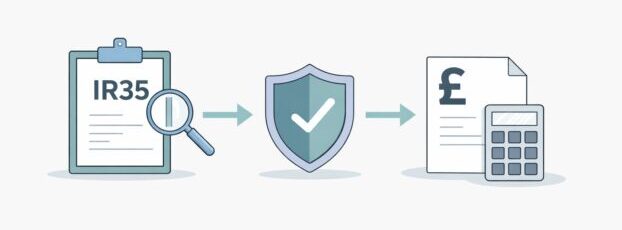
IR35 insurance will protect you against the cost of an HMRC enquiry, and in some cases any tax liabilities that follow.
Most policies are designed to cover two key risks:
- The cost of defending an IR35 investigation
- Any resulting tax, interest and penalties (with full cover)
If you’re new to contracting, or a veteran, you’re almost certain to have heard about IR35. Here we look at how tax investigation insurance works, what it covers, and whether it’s still worth having.
In this guide, we cover the following:
- What IR35 insurance covers
- Types of IR35 insurance
- How to protect yourself from a tax investigation
- Whether IR35 insurance is still worth it
- Where you can buy cover
- Common FAQs
What does IR35 insurance cover?
IR35 insurance typically covers two main areas:
- Professional defence costs – expert representation dealing with HMRC on your behalf
- Tax liabilities – unpaid tax, interest and penalties if you are found to be inside IR35 (with comprehensive cover)
As thousands of contractors will testify, facing a full IR35 enquiry is stressful. Enquiries can last for several years, creating uncertainty for those involved.
Most contractors using expert representation have historically won their cases. However, HMRC has increased resources dedicated to IR35 compliance, and enquiries are becoming more common.
Types of IR35 insurance
There are two main types of IR35 cover available:
- Defence-only policies – cover the cost of professional representation during an HMRC enquiry
- Comprehensive policies – also cover any resulting tax, interest and penalties
The total sums involved in an IR35 case can run into tens of thousands of pounds. Comprehensive cover protects against the financial outcome, not just the process.
Get an IR35 insurance quote from Qdos
Do you need IR35 insurance?
IR35 insurance is primarily relevant where you are responsible for your own IR35 status.
In practice, this usually means contractors working through their own limited companies, where the end client is classified as a ‘small company’ under the off-payroll rules (often referred to as Chapter 8).
You are most likely to benefit from IR35 insurance if:
- You contract via a limited company and fall under the small company exemption (you assess your own IR35 status)
- You take on engagements where the employment status is not completely clear
- You previously worked under Chapter 8 and want protection against a retrospective HMRC enquiry
If you work for medium or large clients (Chapter 10), the responsibility for IR35 usually sits with the client or fee-payer. In these cases, IR35 insurance is typically less relevant.
If you work via an umbrella company, IR35 is not a concern, as you are already taxed as an employee.
How to protect yourself from the costs of an IR35 investigation
The first step is to ensure you have all your contracts reviewed by an employment status specialist.
The wording of your contracts should demonstrate that you are working in the manner of a truly ‘self-employed’ person.
Your working practices (the way you carry out your contract work) should also mirror the terms of the contract.
A contract review is important, but it does not guarantee you are outside IR35.
HMRC enquiries are very thorough; they do not stop at the written contract, but will examine the reality of the working arrangement, including input from your client.
Many contractors, therefore, choose to take out IR35 insurance alongside a contract review.
Who is liable?
The Intermediaries Legislation, implemented in 2000, was introduced to counter ‘disguised employment’.
Under the original rules, the contractor’s own limited company was responsible for assessing IR35 status and paying any additional tax due. This is often referred to as Chapter 8.
However, the off-payroll rules introduced in 2017 (public sector) and extended to the private sector in 2021 shifted that responsibility in many cases.
Where the end client is a medium or large company, the responsibility for determining IR35 status — and the risk of getting it wrong – now sits with the client or fee-payer (Chapter 10).
If the client qualifies as a ‘small company’, the responsibility remains with the contractor’s company. In these cases, IR35 insurance is most relevant, as you are directly exposed to the risk of an HMRC enquiry and any resulting tax liability.
Where can you get IR35 insurance from?
There are several specialist insurers in the contracting market which offer IR35 protection policies.
Some of the leading providers include Qdos, Kingsbridge, IR35 Shield and Markel.
Specialist providers often offer complementary services such as contract reviews and employment status tools.
Get an IR35 Insurance quote from Qdos
IR35 insurance FAQs
Do you still need IR35 insurance if you stop contracting?
It can still be worthwhile to maintain cover even if you stop contracting.
HMRC can investigate your tax affairs going back at least four years, and up to 20 years in more serious cases.
Is IR35 insurance the same as tax investigation insurance?
Usually yes. IR35 cover is typically included within a broader tax enquiry insurance policy, which may also cover VAT, PAYE and other HMRC investigations.
Can I take out cover at any time?
Yes, provided you are not already under investigation. Like any insurance, it must be in place before an issue arises.
Does IR35 insurance cover previous tax years?
Most policies include retrospective cover, typically up to four years.
Is IR35 insurance a legal requirement?
No. It is optional, unlike employer’s liability insurance, but widely used by contractors operating outside IR35.
Can my company pay for IR35 insurance?
Yes. The cost is generally treated as a legitimate business expense and can usually be deducted before Corporation Tax.